Topworks provides custom PPS injection molding in China for manufacturers requiring heat resistance, chemical resistance, electrical insulation and dimensional stability. Our services cover DFM review, injection mold manufacturing, sampling and production.
We review unfilled PPS, glass-filled PPS and mineral-reinforced PPS applications, including PPS GF40 components for automotive, electrical and industrial equipment.
Request a PPS injection molding quote
PPS Injection Molding at a Glance
PPS (polyphenylene sulfide) is a semi-crystalline engineering thermoplastic with low moisture absorption, good chemical resistance and excellent dimensional stability. Glass-reinforced PPS is widely used in components exposed to elevated temperatures and demanding electrical or chemical environments.
| Engineering Parameter | Reference Specification |
|---|---|
| Material | Polyphenylene Sulfide (PPS) |
| Melting Point | Approximately 280–285°C |
| Melt Processing Temperature | 310–340°C for selected commercial grades |
| Mold Temperature | Typically 130–160°C, grade-dependent |
| Material Drying | According to resin supplier requirements |
| Common Reinforcement | 30% or 40% glass fiber |
| Other Material Options | Unfilled PPS, mineral-filled PPS, tribological grades |
| Mold Steel Options | H13 / 1.2344 / S136, subject to tooling requirements |
| Key Tooling Concerns | Flash, abrasion, venting and directional shrinkage |
Processing conditions depend on material grade, reinforcement, part geometry and equipment. The selected resin manufacturer's technical datasheet takes priority over general temperature ranges.
Select Your PPS Material Grade Before Pricing
The reinforcement content of PPS affects mechanical properties, dimensional stability, flow characteristics and tooling wear. A quotation based on unfilled PPS should not be used directly for PPS GF40 production.
| PPS Grade | Typical Applications | Tooling Considerations |
|---|---|---|
| Unfilled PPS | Chemical-resistant components and insulation parts | Crystallinity, shrinkage and flash control |
| PPS GF30 | Electrical housings and structural components | Fiber orientation and abrasion resistance |
| PPS GF40 | Automotive connectors, pump housings and sensor bodies | Hardened steel, gate wear and precision shut-offs |
| Glass and Mineral-Filled PPS | Dimensionally demanding electrical components | Compound-specific shrinkage and flow balance |
| Wear-Resistant PPS | Bearings, gears and sliding components | Surface finish and compound-specific wear control |
Whenever possible, specify the exact commercial grade rather than only the polymer name and glass fiber percentage. Two PPS GF40 compounds may have different melt viscosity, shrinkage and mechanical performance.
Applications of Custom PPS Injection Molding
PPS is frequently selected for parts that must retain their shape and functional performance under heat, humidity and chemical exposure.
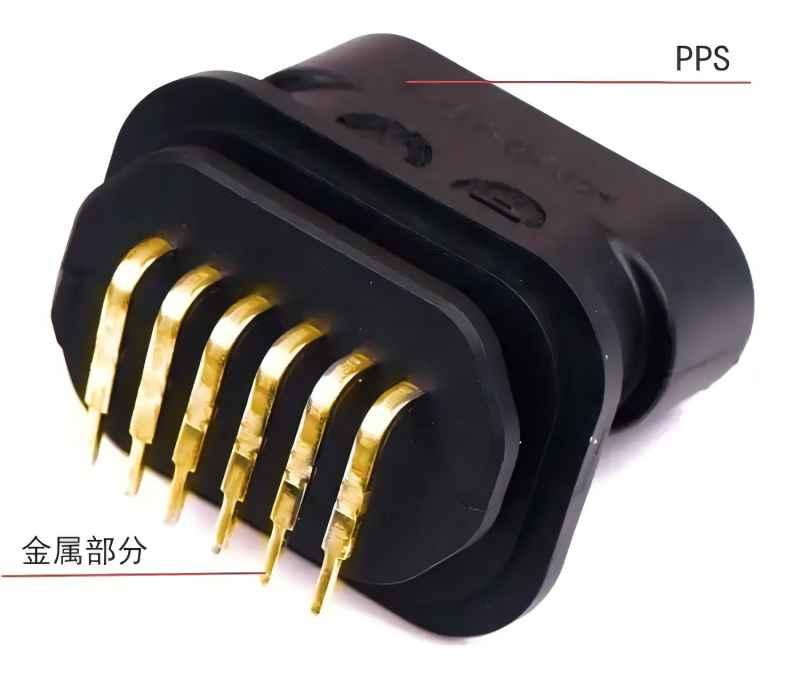
- Automotive: sensor housings, coolant system components, electrical connectors and under-hood parts.
- Electric vehicles: high-voltage connector housings, motor insulation components and selected battery system components.
- Electrical and electronics: coil bobbins, terminal blocks, switches and insulating housings.
- Fluid handling: pump impellers, valve components and chemical-resistant fittings.
- Industrial equipment: precision mechanical components, heat-resistant housings and selected wear parts.
- Consumer appliances: heat-resistant structural components and electrical insulation parts.
PPS GF40 Injection Molding
PPS GF40 contains approximately 40% glass fiber by weight. The reinforcement increases stiffness and generally improves dimensional stability compared with unfilled PPS.
However, the glass fiber also makes the material more abrasive. Gate edges, shut-off surfaces, sliders and moving mold components require particular attention during tooling design.
| Engineering Concern | PPS GF40 Tooling Requirement |
|---|---|
| Gate Wear | Hardened gate surfaces or replaceable inserts |
| Parting Line Flash | Accurate fitting, sufficient support and controlled injection pressure |
| Fiber Orientation | Gate location selected according to dimensional and mechanical requirements |
| Directional Shrinkage | Different shrinkage allowances along and across the melt flow |
| Venting | Controlled vent depth and regular vent maintenance |
| Tool Maintenance | Scheduled inspection of gates, shut-offs and moving components |
A PPS GF40 mold should not simply copy the design of an existing ABS or PP mold. The steel specification, thermal conditions, shrinkage allowances and venting strategy need to be reviewed for the selected compound.
What Changes PPS Injection Molding Scope and Price?
Glass fiber content: Higher reinforcement levels can increase abrasion. Tool steel, hardness, gate inserts and moving component design directly influence mold maintenance costs.
Flash requirements: PPS can produce flash through small gaps in mold shut-off surfaces. Precision electrical components may require tighter mold fitting and more frequent inspection.
Wall thickness and flow length: Thin walls, long flow paths and complex ribs require careful gate positioning and filling analysis.
Metal insert molding: Busbars, threaded inserts and electrical terminals require accurate positioning. Differential thermal expansion between metal and PPS must be considered.
Dimensional tolerances: Reinforced PPS shrinks differently along and across the direction of flow. Gate position and fiber orientation can therefore affect assembly dimensions.
Production volume: Expected shot volume determines steel selection, cavity count, runner design and maintenance requirements. High-output programs may justify a more durable tooling configuration.
Common PPS Injection Molding Defects and Solutions
| Potential Defect | Common Cause | Engineering Control |
|---|---|---|
| Flash | Excessive cavity pressure, worn shut-offs or insufficient mold support | Improve mold fitting, support and pressure control |
| Warpage | Fiber orientation and differential shrinkage | Optimize gate position, wall thickness and mold temperature |
| Short Shot | Restricted flow, premature freezing or trapped gas | Review gate dimensions, temperatures and venting |
| Burn Marks | Trapped gas or excessive local temperature | Improve venting and adjust filling speed |
| Fiber Exposure | Unsuitable surface formation and processing conditions | Optimize mold temperature and filling profile |
| Weak Weld Lines | Melt fronts meeting at insufficient temperature or pressure | Gate relocation, venting and process optimization |
| Gate and Cavity Wear | Abrasive glass fiber reinforcement | Hardened steel and replaceable wear components |
PPS vs PEEK vs PA66: Which Material Is Better?
PPS is often selected when automotive or electrical components require better thermal and chemical stability than conventional nylon grades without the higher material cost of PEEK.
| Property | PPS GF40 | PEEK | PA66 GF30 |
|---|---|---|---|
| Melting Point | Approximately 280–285°C | Approximately 343°C | Approximately 260°C |
| Moisture Absorption | Very low | Low | Relatively high |
| Chemical Resistance | Excellent | Excellent | Environment-dependent |
| Dimensional Stability | Excellent with suitable tooling | Excellent with controlled processing | Affected by moisture conditioning |
| Impact Performance | Grade-dependent, often relatively brittle | Grade-dependent | Good with suitable grades and conditioning |
| Relative Material Cost | High | Very high | Generally lower |
| Typical Selection | Electrical and chemical-resistant parts | Demanding high-performance applications | Cost-sensitive structural components |
PPS is particularly attractive for electrical housings, sensor components and chemically exposed parts. PEEK may be justified for demanding wear and mechanical applications. PA66 remains an economical choice where moisture absorption and operating temperature are acceptable.
Custom PPS Injection Molding Services in China
Topworks manufactures custom injection molds in Huangyan, Taizhou, China. For PPS projects, our engineering review focuses on material behavior, tool durability, dimensional stability and production consistency.
For reinforced PPS, the initial mold price is only one part of the purchasing decision. Flash-related rejects, gate wear, maintenance downtime and unstable dimensions can increase the total cost of production.
Before finalizing a PPS injection molding quotation, we review:
- Exact material grade and reinforcement percentage.
- Critical dimensions, assembly datums and flash limits.
- Gate position and predicted fiber orientation.
- Core and cavity steel requirements.
- Thermal control and injection machine compatibility.
- Expected annual volume and required tool life.
- Inspection, testing and material traceability requirements.
What a Confirmed PPS Injection Molding Quotation Covers
A firm quotation defines the tooling configuration, material grade, inspection scope and delivery terms. This allows purchasing teams to compare suppliers using the same technical requirements.
- DFM review covering wall thickness, draft, gates and critical features.
- Core and cavity steel grades and agreed hardness requirements.
- Hot runner or cold runner configuration.
- Venting, cooling and mold temperature-control layout.
- Slider, lifter and insert molding requirements.
- T1 sampling and agreed dimensional inspection.
- Estimated cycle time, tooling price and molded part cost.
- Tool maintenance recommendations and export packaging.
Frequently Asked Questions About PPS Injection Molding
Can PPS be injection molded?
Yes. PPS is widely processed by injection molding, particularly in glass-reinforced grades used for automotive, electrical and industrial components.
What is the processing temperature for PPS injection molding?
Selected unfilled PPS grades use melt temperatures around 310–320°C, while many glass-reinforced grades require 320–340°C. Mold temperatures of 140°C or above are recommended for many commercial PPS compounds. Exact settings depend on the selected grade.
What is PPS GF40?
PPS GF40 is polyphenylene sulfide reinforced with approximately 40% glass fiber by weight. It offers high stiffness, chemical resistance and good dimensional stability for demanding industrial applications.
Why does PPS produce flash during injection molding?
PPS compounds can flow into small gaps between mold surfaces. Worn shut-offs, mold deflection, excessive cavity pressure and unsuitable vent dimensions can contribute to flash formation.
Does PPS require hardened injection mold steel?
Hardened steel is often recommended for high-volume glass-filled PPS molding because glass fibers cause abrasive wear. H13, 1.2344 and suitable corrosion-resistant mold steels may be considered according to project requirements.
Is PPS cheaper than PEEK?
Generally, PPS resin costs less than PEEK. However, the actual molded part cost also depends on reinforcement, cycle time, tooling investment, material utilization and rejection rate.
Does PPS need drying before injection molding?
Yes, when required by the resin manufacturer. Despite its low moisture absorption, drying may be necessary to remove surface moisture and maintain consistent processing quality.
Can PPS replace metal components?
Glass-reinforced PPS can replace selected metal components where its stiffness, chemical resistance and electrical insulation meet the application requirements. Mechanical loads, impact resistance, creep and operating temperature must be validated.
How much does PPS injection molding cost in China?
The cost depends on PPS grade, part weight, production volume, cavity count, cycle time and tooling specification. A reliable quotation requires a drawing, material specification and expected annual demand.
Technical References
For grade-specific material properties and processing conditions, consult the Celanese FORTRON PPS GF40 technical datasheet and the FORTRON unfilled PPS technical datasheet.
Request a PPS Injection Molding Quote in China
Send us the following information to begin your PPS tooling and production review:
- 3D CAD file, dimensioned drawing or physical sample.
- Exact PPS material grade, including reinforcement content.
- Critical dimensions and acceptable flash limits.
- Operating temperature and chemical exposure.
- Electrical, flame-retardant or mechanical requirements.
- Initial order quantity and expected annual volume.
- Required testing and inspection documentation.
Submit your drawings and specifications through our contact page to request a custom PPS injection molding quotation.