Topworks provides custom plastic injection molding services in China for OEM manufacturers requiring reliable tooling, consistent part quality and repeatable production costs.
From initial design review to mold manufacturing and finished plastic parts, we support low-volume production, mass production, insert molding and overmolding. Our engineering team reviews material selection, part geometry, tooling requirements and production economics before manufacturing begins.
Request a custom injection molding quote
Custom Injection Molding Services at a Glance
Plastic injection molding is a manufacturing process in which molten thermoplastic is injected into a precision-machined mold, cooled and ejected as a finished component. It is particularly suitable for repeat production of complex plastic parts with consistent dimensions and surface quality.
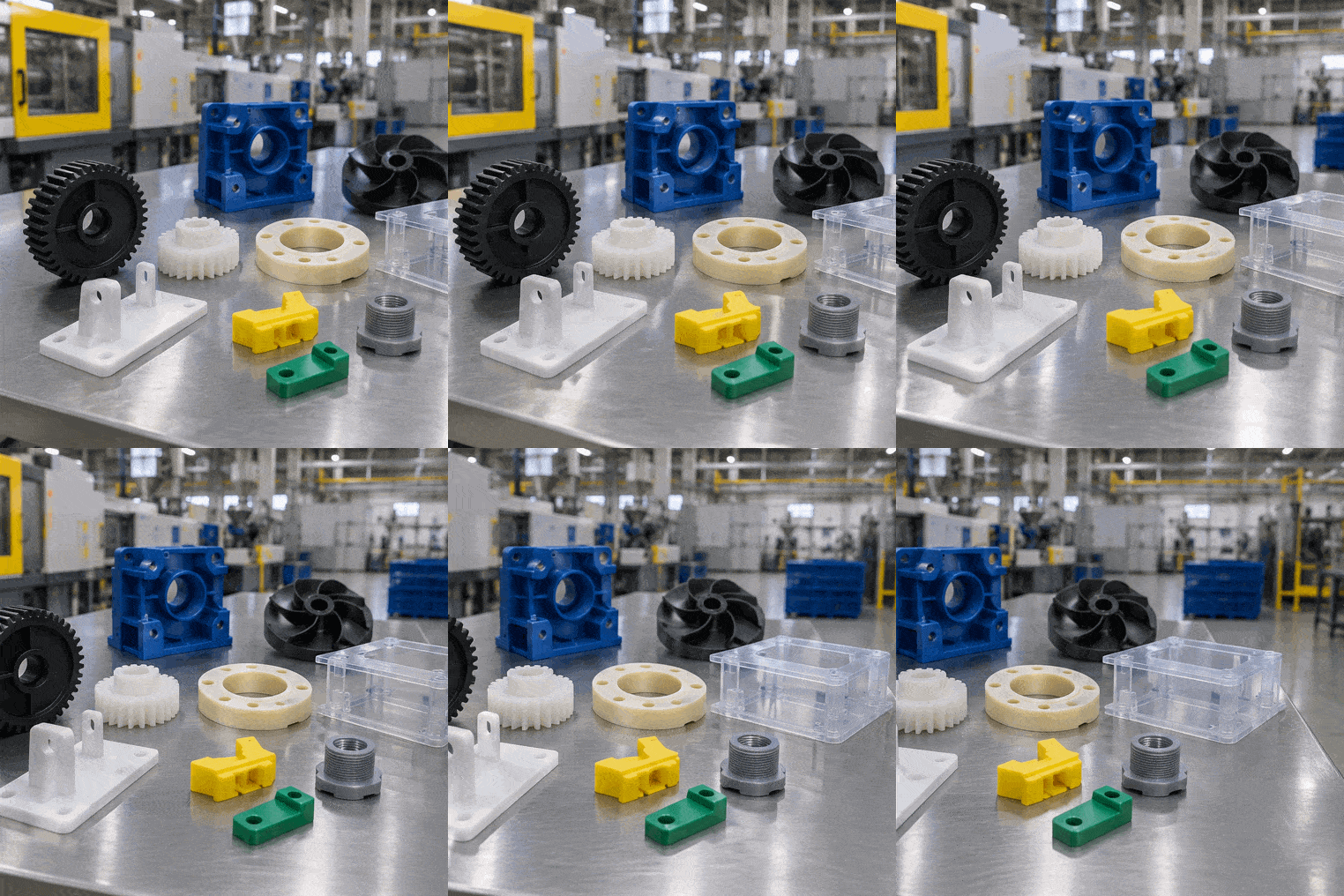
| Manufacturing Requirement | Service Scope |
|---|---|
| Manufacturing Location | Huangyan, Taizhou, Zhejiang, China |
| Manufacturing Services | DFM, mold design, tooling, sampling and injection molding |
| Production Volume | Pilot runs, low-volume and mass production |
| Mold Configuration | Single-cavity, multi-cavity, family mold and hot runner tooling |
| Specialized Processes | Insert molding and overmolding, subject to project requirements |
| Standard Materials | ABS, PP, PE, PC, PA6, PA66, POM and PC/ABS |
| High-Performance Materials | PEEK, PPS and reinforced engineering thermoplastics |
| Tool Steel Options | P20, 1.2738, 718H, NAK80, H13, 1.2344 and S136 |
| Quality Documentation | Dimensional inspection, FAI, material records and agreed PPAP documentation |
| Initial RFQ Response | Target response within one business day |
| Export Markets | North America, Europe and Australia |
Final manufacturing capabilities, production quantities, tolerances and delivery schedules are confirmed during project review.
Our Plastic Injection Molding Services
Custom Plastic Injection Molding
We manufacture plastic components according to customer drawings, approved material specifications and functional requirements.
Each project begins with a review of wall thickness, draft angles, undercuts, assembly features and critical dimensions. These decisions affect mold complexity, part quality and production cost.
Low-Volume Injection Molding
Low-volume injection molding is suitable for product launches, pilot production, replacement components and projects with uncertain annual demand.
Tooling investment can be controlled through simplified mold construction, single-cavity configurations and suitable steel selection. The objective is to meet the required production volume without unnecessary tooling expenditure.
High-Volume Injection Molding
For established production programs, we focus on cycle time, cavity balance, material utilization and mold durability.
Multi-cavity tooling, hot runner systems and automated part handling may reduce unit cost when supported by sufficient production demand.
Insert Molding
Insert molding combines plastic with metal or other preformed components during injection molding. Typical applications include threaded inserts, electrical terminals, metal bushings and structural reinforcements.
Insert positioning, retention strength, flash control and thermal expansion must be reviewed before mold manufacturing.
Overmolding
Overmolding combines two materials or components to produce a finished part with additional grip, sealing, protection or functional properties.
Material compatibility, bonding strength, mechanical interlocks and molding sequence determine whether a particular overmolding application is feasible.
Precision Injection Molding
Precision injection molding requires more than accurate mold machining. Material shrinkage, process variation, cavity pressure, temperature control and measurement conditions also affect finished part dimensions.
We review critical-to-quality dimensions individually rather than assigning the same tight tolerance to every feature.
Injection Mold Design and Manufacturing
Our tooling services cover mold design, CNC machining, EDM, wire cutting, fitting, polishing, assembly and trial molding.
Customers can order injection molds for their own production facilities or combine tooling and molded part production within the same project.
Learn more about our mold design and manufacturing services.
Which Injection Molding Service Do You Need?
| Project Requirement | Recommended Manufacturing Approach | Main Purchasing Consideration |
|---|---|---|
| Prototype Validation | 3D printing, CNC machining or prototype tooling | Design flexibility before tooling investment |
| New Product Launch | Single-cavity or low-volume injection molding | Initial investment and market uncertainty |
| Stable Annual Demand | Production-grade injection tooling | Repeatability, tool life and unit cost |
| High-Volume Production | Multi-cavity or hot runner tooling | Cycle time, cavity balance and material utilization |
| Plastic and Metal Components | Insert molding | Insert position, retention and flash control |
| Soft-Touch or Sealing Components | Overmolding | Material compatibility and bonding |
| High-Temperature Components | Engineering polymer injection molding | Material grade, thermal control and tooling durability |
| Existing Mold Transfer | Tool inspection and production feasibility review | Mold condition and machine compatibility |
The lowest tooling price is not always the most economical manufacturing option. The appropriate production method depends on expected lifetime demand, part complexity and required quality.
Plastic Materials for Custom Injection Molding
Material selection determines part performance, processing conditions, mold construction and long-term manufacturing cost. We review standard thermoplastics and high-performance engineering polymers according to the actual application.
| Material | Main Properties | Typical Applications |
|---|---|---|
| ABS | Good impact resistance and cosmetic appearance | Electronic housings, appliance covers and automotive trim |
| Polycarbonate (PC) | Transparency, impact resistance and heat resistance | Clear covers, lighting components and protective housings |
| Nylon (PA6 / PA66) | Mechanical strength and wear resistance | Gears, connectors, brackets and mechanical components |
| PPS | Chemical resistance and thermal stability | Electrical connectors, sensor housings and pump components |
| PEEK | High-temperature performance and chemical resistance | Specialized mechanical and industrial components |
| PP | Low density, chemical resistance and flexibility | Packaging, automotive components and household products |
| HDPE | Impact resistance and chemical resistance | Containers, crates and industrial products |
| POM | Low friction and good dimensional stability | Precision gears, sliding components and mechanical parts |
| PC/ABS | Balanced impact resistance and processability | Automotive interiors and equipment housings |
| TPE / TPU | Flexibility and elastic properties | Grips, flexible covers and selected sealing components |
| PMMA | Optical clarity and surface appearance | Transparent covers, displays and lighting components |
The material name alone is not sufficient for a confirmed quotation. The commercial grade, reinforcement, color, additives and required performance should be specified.
Engineering Plastic Injection Molding Services
PEEK Injection Molding
High-performance components requiring elevated operating temperatures, wear resistance and chemical resistance. Tooling design must account for high processing temperatures, crystallinity and expensive resin consumption.
PPS Injection Molding
Unfilled and reinforced PPS components for electrical, automotive and industrial applications. Particular attention is given to flash control, glass fiber abrasion and directional shrinkage.
Polycarbonate Injection Molding
Transparent, thick-wall and impact-resistant PC components. Engineering controls include material drying, gate freeze evaluation, optical surface quality and residual stress reduction.
ABS Injection Molding
Custom ABS housings, cosmetic components and consumer products. Tooling requirements focus on visible surfaces, sink mark prevention, assembly accuracy and secondary finishing.
Nylon Injection Molding
PA6, PA66 and glass-reinforced nylon components. Critical considerations include moisture absorption, dimensional conditioning, tool wear and fiber orientation.
Industries We Serve
| Industry | Typical Injection Molded Components | Engineering Priority |
|---|---|---|
| Automotive | Interior trim, exterior components, connectors, brackets and housings | Assembly accuracy, appearance and durability |
| Electrical and Electronics | Enclosures, terminal blocks, connectors and insulating components | Dimensional accuracy, electrical insulation and material compliance |
| Home Appliances | Control panels, handles, covers and internal structural parts | Surface finish, assembly fit and production cost |
| Medical Equipment | Device housings and selected functional components | Material traceability, cleanliness and project qualification |
| Industrial Equipment | Gears, bushings, pump components and protective housings | Mechanical performance and dimensional stability |
| Consumer Products | Plastic furniture, storage products, cases and accessories | Appearance, durability and unit cost |
| Packaging | Caps, containers, closures and thin-wall products | Cycle time, cavity balance and material utilization |
Applications with regulatory, safety or performance requirements are reviewed individually. The suitability of a material or manufacturing process must be confirmed against the customer’s specification.
Design for Manufacturability Before Mold Manufacturing
Many injection molding defects originate in the product design rather than the molding machine. Correcting these issues before steel cutting is generally faster and less expensive than modifying a completed mold.
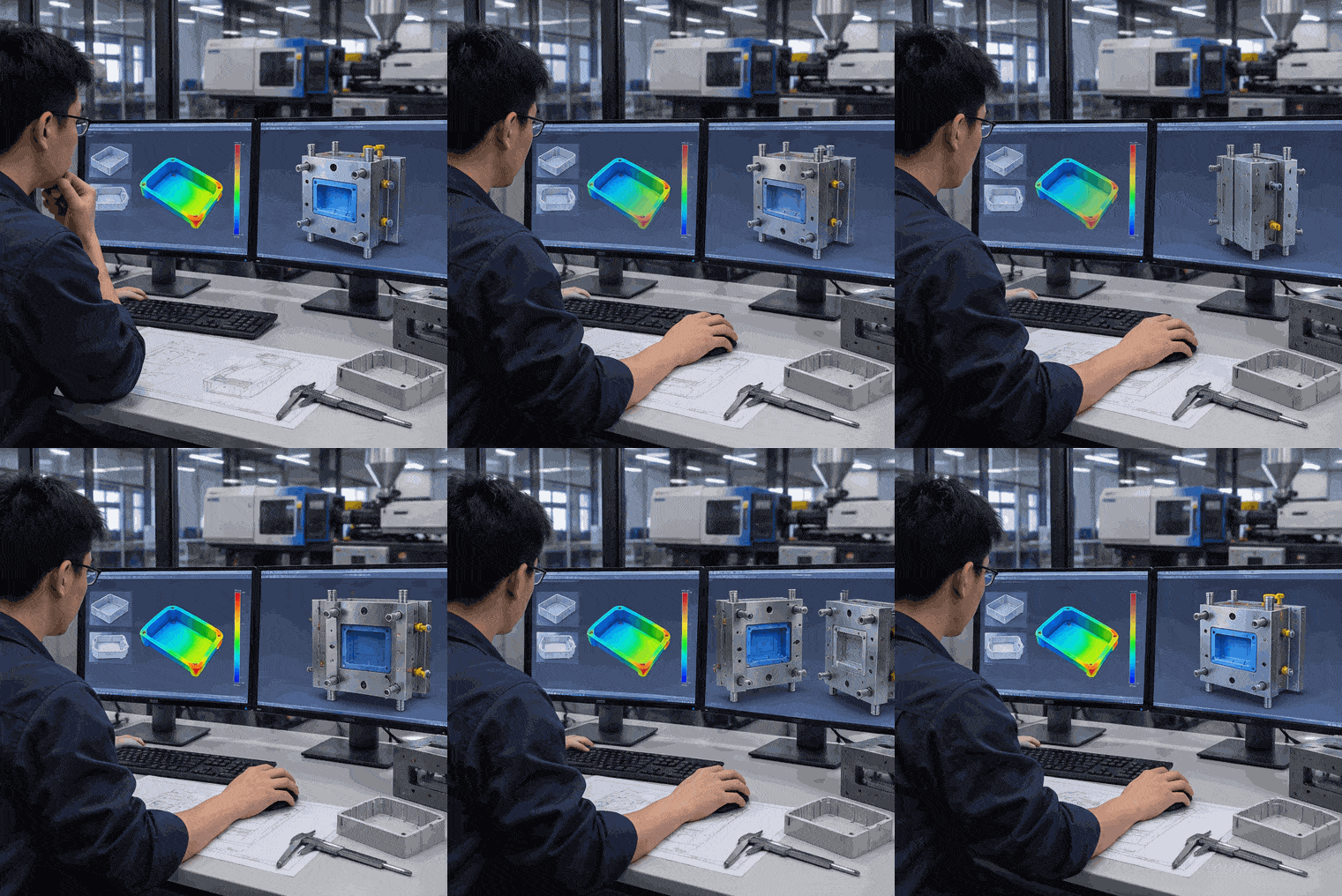
| Design Feature | Initial Engineering Guideline | Manufacturing Objective |
|---|---|---|
| Wall Thickness | Approximately 1.5–3.0 mm for many conventional housings | Balance filling, stiffness and cooling |
| Rib Thickness | Approximately 40–60% of nominal wall thickness | Reduce sink marks on visible surfaces |
| Draft Angle | Generally 1–2° as an initial reference | Improve part release |
| Textured Surfaces | Additional draft according to texture depth | Prevent scuffing during ejection |
| Internal Corners | Suitable radii instead of sharp corners | Reduce stress concentration |
| Undercuts | Review sliders, lifters or design alternatives | Control tooling complexity |
| Gate Location | Based on filling, appearance and functional requirements | Control weld lines, packing and deformation |
| Critical Tolerances | Specified individually according to function | Avoid unnecessary tooling and inspection costs |
These are general design references, not universal design limits. Thin-wall packaging, thick-wall optical parts and reinforced polymers require application-specific evaluation.
Our DFM review also considers parting lines, cooling circuits, venting, ejector positions and material-specific shrinkage before the mold design is finalized.
Our Injection Molding Manufacturing Process
Step 1: RFQ and Technical Review
We review your 3D files, drawings, material specification, annual volume and quality requirements. Missing information is identified before a firm quotation is prepared.
Step 2: DFM and Tooling Strategy
The engineering team evaluates moldability, gate position, parting lines, cooling requirements, undercuts and critical dimensions.
Step 3: Mold Design Approval
Mold configuration, cavity count, steel grades, runner system and machine compatibility are reviewed before steel cutting begins.
Step 4: Mold Manufacturing
Tooling components are machined, heat-treated where required, polished and assembled according to the approved design.
Step 5: T0 and T1 Trial Molding
Initial trials evaluate filling, ejection, appearance, dimensions and process stability. Necessary corrections are identified before production approval.
Step 6: Sample Approval
Samples are submitted with the agreed inspection documentation. Production begins after required corrections and customer approval.
Step 7: Pilot or Mass Production
Production conditions are established according to the approved samples, resin specification and quality requirements. Cycle time and rejection rates are monitored according to the agreed control plan.
Step 8: Inspection, Packaging and Shipment
Finished parts are inspected, packaged and prepared for shipment according to customer requirements and agreed delivery terms.
How Much Do Injection Molding Services Cost in China?
Injection molding cost consists of two main elements: the initial tooling investment and the recurring cost of manufacturing each acceptable plastic component.
| Cost Element | What Determines the Cost |
|---|---|
| Mold Manufacturing | Part size, complexity, cavity count, steel grade and mold life |
| Plastic Material | Resin grade, part weight, runner weight and material losses |
| Machine Cost | Required clamping force, machine rate and molding cycle |
| Labor and Automation | Insert loading, part removal, trimming and handling |
| Quality Control | Inspection frequency, testing and documentation |
| Secondary Operations | Painting, printing, assembly and other finishing requirements |
| Packaging and Logistics | Packaging method, shipment volume and delivery terms |
| Production Losses | Rejected parts, startup scrap and maintenance downtime |
A reliable quotation should identify these cost drivers rather than providing only a mold price and a nominal piece price.
Compare Total Injection Molding Cost, Not Just Mold Price
When sourcing injection molding services from China, compare the total manufacturing cost over the expected production volume.
A simplified calculation is:
Effective Cost per Good Part = Tooling Cost / Accepted Quantity + Production Cost per Good Part
The following example illustrates why a more expensive mold may produce a lower total manufacturing cost.
| Cost Comparison | Tooling Option A | Tooling Option B |
|---|---|---|
| Mold Investment | $8,000 | $12,000 |
| Cost per Accepted Part | $0.65 | $0.50 |
| Production Quantity | 100,000 | 100,000 |
| Total Production Cost | $65,000 | $50,000 |
| Total Cost Including Tooling | $73,000 | $62,000 |
| Effective Cost per Part | $0.73 | $0.62 |
In this example, an additional $4,000 tooling investment reduces the total manufacturing cost by $11,000 over 100,000 accepted parts.
The break-even point is approximately 26,667 parts. Below this quantity, Option A is more economical. Above it, Option B provides a lower combined tooling and production cost under the stated assumptions.
This is an illustrative cost comparison, not an actual customer quotation. Freight, taxes, financing, mold replacement and other project-specific expenses are excluded.
Injection Molding Cycle Time and Production Efficiency
Cycle time directly affects the machine cost per molded component. It includes mold closing, injection, holding, cooling, mold opening and part ejection.
Cooling often represents the largest portion of the molding cycle, particularly for thick-wall components.
Consider a hypothetical four-cavity mold operating continuously:
| Production Parameter | Original Cycle | Optimized Cycle |
|---|---|---|
| Cavity Count | 4 | 4 |
| Cycle Time | 40 seconds | 30 seconds |
| Cycles per Hour | 90 | 120 |
| Theoretical Parts per Hour | 360 | 480 |
| Machine Hours for 100,000 Parts | 277.8 | 208.3 |
Reducing the cycle from 40 seconds to 30 seconds increases theoretical output by 33.3% and reduces required machine hours by 25%.
However, faster molding is only beneficial when dimensional accuracy, surface quality and functional performance remain acceptable.
This calculation assumes continuous operation without downtime, rejected parts or changeovers. Actual production output will be lower.
Injection Molding Quality Control
Quality control begins with the approved product drawing and material specification. Inspection requirements should be agreed before mold manufacturing, not after the first production shipment.
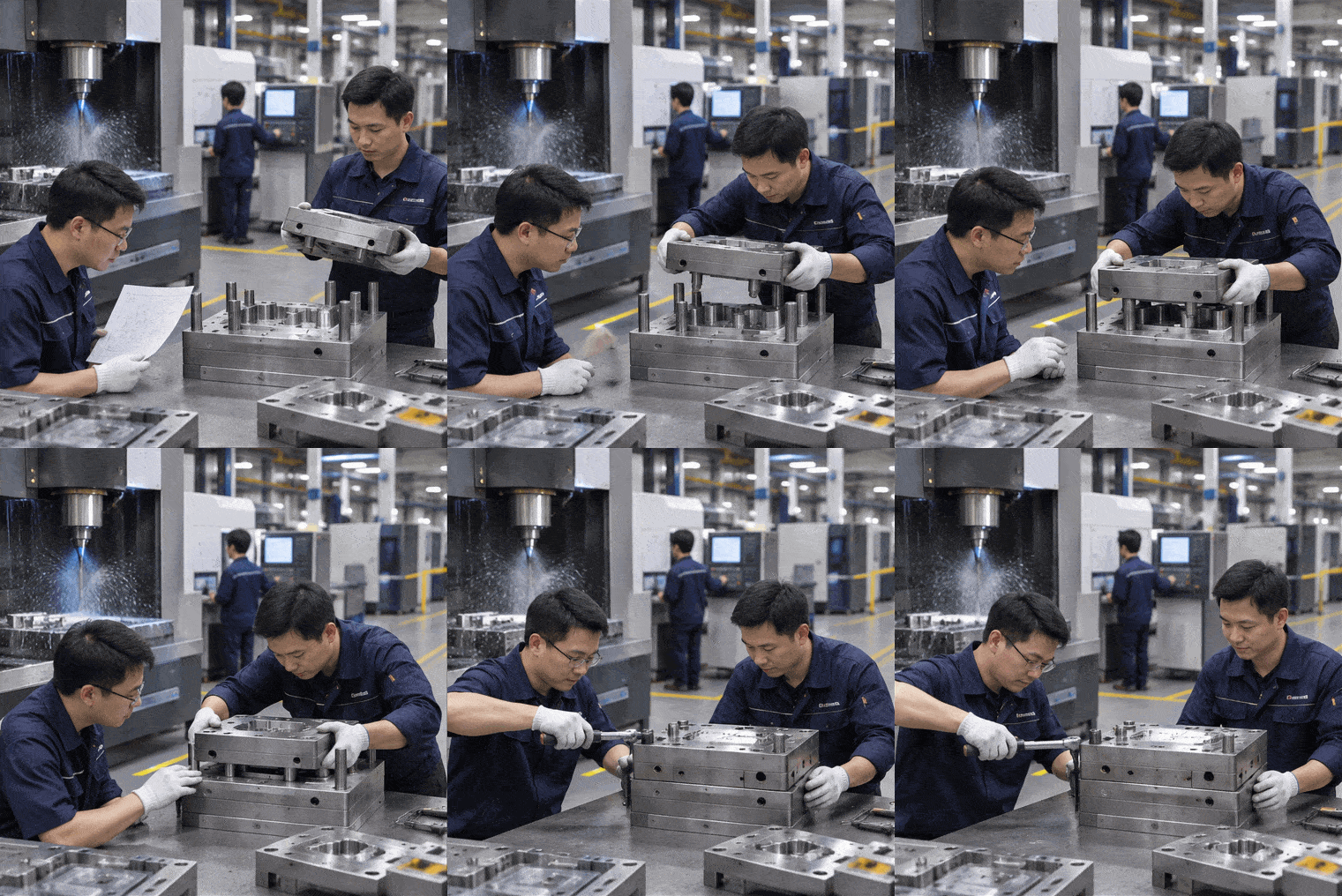
| Quality Control Stage | Inspection Focus | Typical Deliverable |
|---|---|---|
| Material Verification | Grade, reinforcement, color and batch identification | Material records or agreed supplier certificates |
| Mold Manufacturing | Steel specification, hardness and critical tooling dimensions | Tooling inspection records |
| Trial Molding | Filling, appearance, dimensions and process feasibility | Trial samples and inspection results |
| First Article Inspection | Dimensions specified on the approved drawing | FAI report where agreed |
| Production Inspection | Critical dimensions, appearance and process consistency | In-process inspection records |
| Final Inspection | Agreed acceptance criteria and packaging requirements | Final inspection report |
For automotive and other controlled manufacturing programs, additional documentation such as PPAP, process capability studies and material traceability can be discussed during the RFQ stage.
Common Injection Molding Defects and How We Address Them
| Potential Defect | Common Engineering Cause | Recommended Control |
|---|---|---|
| Flash | Mold gaps, excessive cavity pressure or insufficient support | Precision shut-offs, mold fitting and pressure control |
| Sink Marks | Thick ribs, bosses or insufficient packing | Geometry optimization, gate sizing and effective holding |
| Warpage | Uneven cooling, shrinkage or fiber orientation | Cooling balance, gate optimization and geometry review |
| Short Shot | Restricted flow, premature freezing or trapped air | Review gate dimensions, processing temperatures and venting |
| Weld Lines | Separated melt fronts meeting inside the cavity | Gate positioning, filling control and venting |
| Burn Marks | Trapped compressed air or material degradation | Improve venting and control filling conditions |
| Silver Streaks | Moisture, volatile gases or degradation | Material drying and temperature control |
| Internal Voids | Volumetric shrinkage inside thick sections | Gate freeze evaluation and packing optimization |
| Ejector Marks | High release force or unsuitable ejection layout | Review draft, polishing and ejector distribution |
| Dimensional Variation | Unstable processing or material behavior | Process monitoring and material-specific inspection |
Defect correction may require changes to the molding process, product geometry or mold construction. Increasing injection pressure or temperature is not a universal solution.
Why Source Custom Injection Molding Services from China?
China has an established supply chain for plastic injection molds, engineering materials, hot runner systems, standard mold components and precision machining.
For international OEM buyers, the main opportunity is to combine tooling manufacturing and molded part production within a coordinated supply chain.
However, sourcing decisions should be based on engineering capability and documented manufacturing requirements rather than country of origin or price alone.
| Purchasing Risk | What Buyers Should Verify |
|---|---|
| Unclear Tooling Ownership | Written ownership and mold transfer terms |
| Material Substitution | Approved commercial resin grade and traceability requirements |
| Underestimated Mold Cost | Steel, cavity count, runner system and included trial scope |
| Unexpected Production Charges | Part price, packaging, finishing and inspection scope |
| Unstable Quality | Approved samples, critical dimensions and production control plan |
| Delivery Delays | Defined design approval, trial and production milestones |
| Mold Maintenance Problems | Tool life specification, maintenance responsibilities and spare components |
| Intellectual Property Concerns | Confidentiality agreements and project information controls |
Topworks: Your Injection Molding Manufacturer in China
Topworks Plastic Mold is a custom injection mold manufacturer based in Huangyan, Taizhou, Zhejiang, China. We support international customers with mold engineering, tooling manufacturing and plastic part production.
Combining mold manufacturing and injection molding allows tooling decisions to be evaluated against actual production requirements. Gate design, cooling efficiency, ejection reliability and maintenance accessibility all influence long-term manufacturing cost.
Our engineering approach focuses on:
- Reviewing part design before steel cutting.
- Selecting tooling specifications according to expected production volume.
- Matching resin requirements with suitable molding equipment.
- Identifying critical dimensions and cosmetic surfaces.
- Evaluating cycle time and material consumption.
- Documenting tooling revisions and sample approval.
- Controlling production quality according to agreed requirements.
Learn more about our factory and manufacturing background.
Is Our Injection Molding Service Right for Your Project?
Suitable Projects
- OEM manufacturers developing custom plastic components.
- Companies requiring both injection molds and finished plastic parts.
- New product launches with planned repeat production.
- Engineering plastic components requiring material-specific tooling.
- Existing products requiring tooling replacement or manufacturing improvements.
- International buyers seeking documented tooling and production requirements.
When Injection Molding May Not Be the Best Option
- One-off plastic components without planned repeat orders.
- Early prototypes that require frequent geometry changes.
- Projects where tooling investment exceeds the expected manufacturing savings.
- Applications with performance requirements that cannot be met by the selected material.
For these projects, CNC machining, 3D printing or another manufacturing process may be more appropriate.
What a Confirmed Injection Molding Quotation Covers
A confirmed quotation should define the complete manufacturing scope so that buyers can compare suppliers on equivalent technical and commercial terms.
- Approved product geometry and material specification.
- Mold configuration and cavity count.
- Core and cavity steel grades.
- Hot runner or cold runner configuration.
- Required surface polishing or texture.
- Expected tool life and maintenance responsibilities.
- Estimated cycle time and material consumption.
- Tooling price and molded part price.
- Sampling and dimensional inspection scope.
- Secondary operations and assembly requirements.
- Packaging, delivery schedule and shipment terms.
- Mold ownership and transfer conditions.
Frequently Asked Questions About Injection Molding Services
What are plastic injection molding services?
Plastic injection molding services involve manufacturing plastic components by injecting molten resin into a mold. The complete service may include product design review, mold manufacturing, trial molding, production, inspection and packaging.
How much does custom injection molding cost in China?
Cost depends on part geometry, resin grade, mold steel, cavity count, annual volume and quality requirements. A complete quotation should separate tooling investment from recurring production cost.
What is the minimum order quantity for injection molding?
There is no universal minimum order quantity. Economical production volume depends on mold investment, machine setup, material requirements and the finished component. Low-volume programs are evaluated individually.
How long does injection mold manufacturing take?
Many conventional injection molds require approximately 30–60 days from approved mold design to trial or delivery readiness. Complex, large or high-precision tooling may require longer. The exact schedule is confirmed during quotation.
Can you manufacture both the mold and plastic parts?
Yes. Topworks supports mold manufacturing and injection molding production. Customers may purchase the mold for their own factory or retain it for ongoing production in China under agreed ownership terms.
What materials can be used for custom injection molding?
Common materials include ABS, PP, PE, polycarbonate, nylon, POM and PC/ABS. High-performance materials such as PPS and PEEK can be reviewed according to their processing and application requirements.
What tolerances can injection molding achieve?
Achievable tolerances depend on part size, material shrinkage, geometry, mold construction and processing conditions. Critical dimensions should be evaluated individually according to the approved drawing.
Can you provide low-volume injection molding services?
Yes. Low-volume production can be evaluated using simplified tooling, single-cavity molds or other suitable configurations. The most economical approach depends on expected lifetime demand.
Can you use an existing injection mold?
Existing molds can be reviewed for mechanical condition, cooling circuits, runner configuration, electrical connections and injection machine compatibility before production acceptance.
Who owns the injection mold?
Mold ownership is defined in the purchase agreement. Buyers should confirm ownership, storage, maintenance and transfer rights before tooling begins.
Can you manufacture parts with metal inserts?
Yes. Insert molding can be considered for threaded inserts, terminals, bushings and other metal components. Insert retention, positioning and flash requirements must be verified.
How do you control injection molding quality?
Quality control combines approved material specifications, trial samples, dimensional inspection, production monitoring and agreed acceptance criteria. Documentation requirements are confirmed during the RFQ stage.
Can I request an NDA before sending my CAD files?
Yes. Confidentiality and NDA requirements can be discussed before detailed product information is submitted.
How do I choose an injection molding company in China?
Evaluate the supplier’s tooling capability, material experience, DFM process, quality documentation and production cost assumptions. Confirm mold ownership and maintenance terms before placing an order.
What information is required for an injection molding quote?
Send your 3D CAD file, material grade, critical dimensions, annual production volume and surface requirements. Additional assembly, testing, packaging and delivery details improve quotation accuracy.
Request a Custom Injection Molding Quote in China
Send your project details to our engineering team for an initial manufacturing and tooling review.
- 3D CAD file in STEP or IGES format.
- 2D drawing with critical dimensions and tolerances.
- Required plastic material and commercial resin grade.
- Color, reinforcement and additive requirements.
- Initial order quantity and expected annual volume.
- Expected mold life and production location.
- Surface finish and cosmetic requirements.
- Metal inserts and assembly requirements.
- Inspection, testing and documentation requirements.
- Target delivery date and shipment destination.
If your product design is not finalized, we can begin with an initial feasibility review using available drawings, sketches or reference samples.
Send us your project requirements. Our target is to provide an initial response within one business day.