Material, tooling and inspection requirements vary with the application. We review the operating conditions and assembly requirements before tooling starts.
Automotive
Exterior and interior trim, housings, brackets and functional components. Most exterior parts run in PP with EPDM, ASA, or PC/ABS. These grades hold up to sun, road salt, and wash chemicals. Interior trim needs low gloss, low odour, and a steady grain. PA6 with 30% glass fibre suits brackets that carry load and heat. POM works for gears, clips, and sliding parts that must wear slowly. Hold clip holes and mating faces to ±0.10 mm where parts snap together. Glass fibre cuts shrinkage along flow and leaves more across flow.
Check warpage after heat soak, and again at room temperature. A part that fits cold can bow after a day in a hot car. Ask for PPAP Level 3, a full dimensional report, and material certificates before first shipment. Track Cpk on the few dimensions that set fit, not on every edge. Common faults show up as sink marks behind ribs, weld lines on show faces, and clips that crack at -30 °C. Send the assembly drawing, the mating part, and the test temperature with the RFQ. A mould quote without those three inputs is a guess. For large exterior tooling, see our automotive bumper moulds.
Electronics & Electrical
Electrical enclosures, connectors, switch housings and insulation components. Resin grades are selected against the specified electrical and thermal requirements. PC and PC/ABS cover most enclosures that need impact strength and a clean finish. PBT with glass fibre suits connectors that see heat and repeated mating. PPS and LCP suit small, thin parts that run hot and must hold pitch. Ask for UL 94 V-0 at the actual wall thickness, not at 3.0 mm only. A grade rated V-0 at 3.0 mm can fail at 1.0 mm.
Check the CTI value and the RTI rating when the part sits near live parts. PA66 absorbs moisture, so dry it well and check size after conditioning. Hold pin holes and pitch to ±0.05 mm on connectors. A 0.10 mm shift can turn a smooth plug-in into a forced fit. Watch weld lines near pins and thin ribs. They cut strength where the part works hardest. Confirm RoHS and REACH paperwork with each resin lot, and keep the UL Yellow Card on file. An IP rating needs seals, screws, and a flat mating face, not plastic alone. Send the pin layout, the mating connector, and the test voltage with the drawing.

Home Appliances
Housings, covers, handles, control panels and internal components. ABS still does most housings, covers, and control panels. It takes colour well, holds a gloss or matte grain, and resists daily knocks. PP suits tubs, tanks, and parts that meet water or detergent. Use a food-contact grade where the part touches food or drinking water. Ask for the grade sheet and the food-contact declaration before tooling. PC/ABS suits thin covers that need more heat resistance than ABS alone.
Hold visible faces free of sink marks, gate marks, and flow lines. Move the gate to a hidden edge when the show face must stay clean. Match colour under the light the buyer will use, and check it again in daylight. A handle that feels solid on day one can creep and loosen after months of use. Test hinges and latches through their full cycle count. Check flame rating, RoHS paperwork, and the resin lot before each run. Send a surface sample, the colour chip, and the assembly force with the order. For ABS parts in this range, see our ABS injection molding page.
Industrial Products
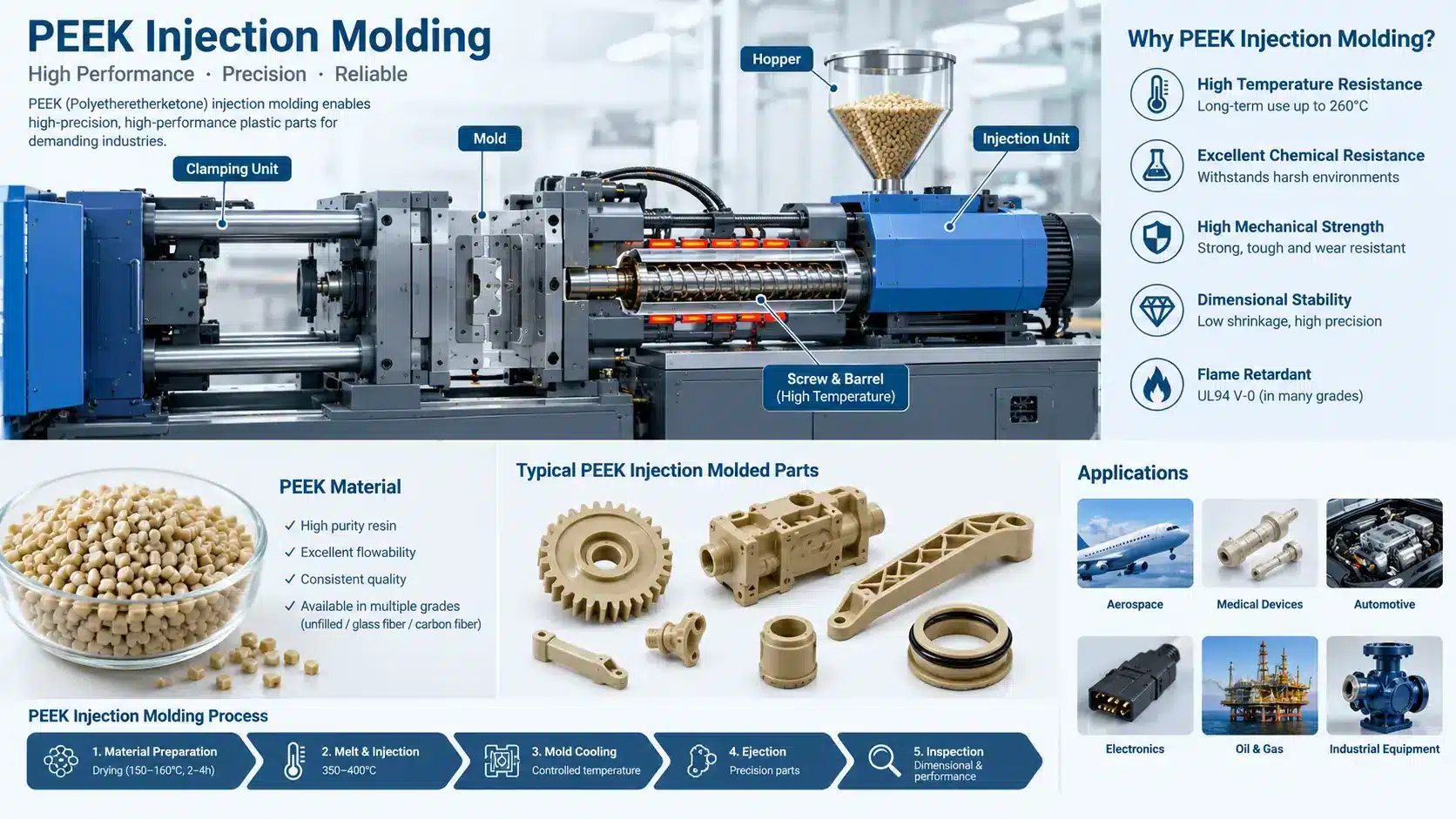
Equipment covers, protective housings and custom engineering plastic parts. PA6 and PA66 with 30% glass fibre cover most loaded covers and brackets. POM suits gears, rollers, and sliding parts that run dry. PPS and PEEK suit hot, chemical, and loaded jobs where cheaper resins creep. Check the load, the temperature, and the chemical list before you pick a grade. A resin that passes at 23 °C can sag at 80 °C under the same load. Glass fibre cuts shrinkage along flow and leaves more across flow.
That split drives warpage on flat covers, so set the gate and the rib layout with it in mind. Hold bores, mating faces, and insert positions to ±0.05 mm where parts must line up. Test brass inserts for pull-out and torque, and check fit too. A loose insert fails in the field, not on the bench. Confirm RoHS and REACH paperwork, and ask for a first-article inspection report. Outdoor parts need UV stabiliser and a grade rated for the service temperature. Send the load case, the mating metal part, and the duty cycle with the drawing. That set lets the moulder check creep, wear, and fit before steel is cut.
Packaging
Buckets, lids, containers and other molded packaging products. PP leads thin-wall buckets, lids, and food containers. It flows fast, seals well, and takes in-mould labels without extra steps. HDPE suits bottles, caps, and containers that need stiffness and chemical resistance. Use a food-contact grade and keep its declaration on file for every lot. Hold wall thickness to 0.6-1.0 mm on thin-wall parts, and keep it even. Thin spots cool first and pull the rim out of round.
Test the lid seal after stacking. A lid that seals on day one can leak after the stack load sits for a week. Run a drop test at the coldest temperature the product will meet. PP turns brittle in the cold, and a thin rim is the first place to crack. Check the seal face for flash, since a thin fin breaks the seal. Confirm the fill volume, the stack load, and the label artwork before tooling. Send a filled sample, the lid, and the test temperature with the order. For thin-wall bucket tooling, see our paint bucket mould page.